Wednesday, 23 November 2011

Goat Farming

       Agriculture and allied activities support livelihoods of nearly 70 percent of India’s rural population. In recent years, land based livelihoods of small and marginal farmers are increasingly becoming unsustainable, since their land has not been able to support the family’s food requirements. As a result, rural households are forced to look at alternative means for supplementing their livelihoods.
Apart from farm activities, farm community needs extra income from other occupations. From this they can earn much more income compared to other sectors. They are engaged with these activities when they are in adverse conditions.i.e time not suitable for farming like more drought and flood conditions. That time, this income will save their family needs and savings.

There are many non farm occupations are there like goat farming, mushroom cultivation, emu farming, silkworm culture, poultry farming, vermi compost making etc..,

Goat farming:
          Goat is known as ‘Poor man’s cow’ in India and is a very important occupation in dry land farming system. Suitable for small and marginal  and landless laborers. It needs less grazing lands and initial investment is low.Risk of goat farming is less compared to other livestocks species. It is a economically viable sector to the rural people. They are resistant to diseases. In a short period we can get more revenue.

 
Semi intensive method


Wednesday, 16 November 2011

Amla Tree - Nellikai, Phyllanthus Embilca (Emblica offcinalis)

Amla(Aonla)  is a indian gooseberry native to India. Amla has a high medicinal and Ayuervedic properties. The fruits have the great source of vitamin C. A small fruit of amla is equal to 2 oranges in terms of vitamin C content. It is used as a good liver tonic in Ayurveda medicines. Apart from medicines the fruit juice extract is used in shampoo preparations and oil, hair dyes. It is also a very important ingredient in the famous Chyavanaprash, and a constituent of Triphala (three fruits) powder. It helps the digestion, prevent the dysentery, cleanses the liver. The dried fruit powder used in a cosmetic sectors as a removing age spots. It also reduces the blood sugar level. So over all it has the highly medicinal values. Obviously the plant have a greater demand nowadays.

Amla Fruit

Cultivation methods:
                              
Soil and climate:
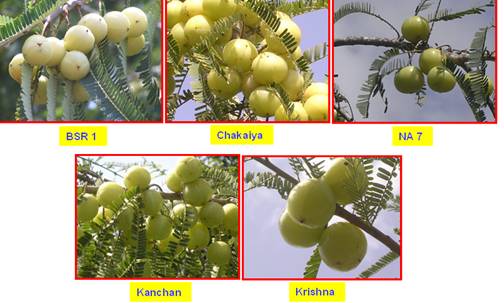
           Good fertile and loamy soil is suitable for cultivation. Sandy soils also recommended. Water logged conditions not suitable .There are some good hybrid varieties such as Banarasi, Chakaiya, Kanchan, Krishna, NA6. Black and red soils also suitable for cultivation. The tree can grown in dry regions also.


Land preparation:
            Early period of monsoon is good time of planting. During May to june is best time for land preparations. First the field should be well ploughed and levelled. With the distance of  7-10m distance of pit digged with the depth of 1 cubic meter. Pit was exposed to sunlight for 20 days, then filled with 15 kg of FYM(farm yard manure) .


Wednesday, 9 November 2011

Gloriosa superpa(Glory lily, kanvazhi/kalappai kilangu)

Gloriosa superpa is one of the medicinal plant grown as a commercial crop and will give good returns. NABARD is providing the loans around 80-90% for cost of cultivation for it.Among the medicinal crops it gives more returns like cash crops.
Other names: Kalihari, Glory Lily, Flame lily.

Gloriosa
General information:
                    It is an annual climbing perennial herb with tuberous roots. Growing between 3.5 to 6 m in length. Tubers and seeds contain colchicine, isoperlolyrine and related tropolane alkaloids, sitosterol and its glucoside, 2-hydroxy 6-methoxy benzoic acid.Flower’s contain Luteolin, its Glucoside, N-Formyl-de-Me-colchicine, its Glucoside and 2-de-Me-colchicine. The colchicine content varies from 0.15 to 0.3% in the tubers and 0.7 % to 0.9% in the seeds.


Sunday, 6 November 2011

National Conference - Changing Scenario of Food Science, Technology and Agricultural Products

National Conference on
“Changing Scenario of Food Science, Technology and Agricultural Products”


Date:    November 11-12, 2011

Venue: JHANSI, UTTAR PRADESH, India

For further details visit,
http://iftbu.org/seminar.htm